

Run To Feel: How I ran 8:18 at Gone Nuts 75km
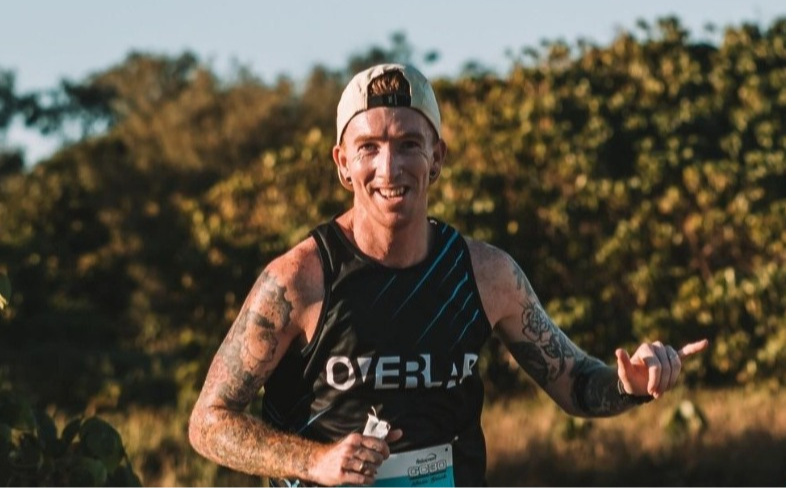
Gone Nuts 75 km – 8:18 – 2nd place.
I went into this race very blasé.
My mind has been so fixated on the UTA 100 Miler that I looked at Gone Nuts as just another training run. And in many ways, that’s exactly what it was. The priority for the day was to treat the race as preparation for UTA: dial in my gear, refine my nutrition, and identify any weaknesses I’ll need to work on over the coming months.
It wasn’t until a few days before race day that it really clicked: it’s still 75 kilometres.
That realisation brought a little more respect for the task ahead. I put some more thought into the race plan, but even so, I rocked up to the start line feeling surprisingly relaxed. Something about having done multiple 50s and 100s changes your relationship with these events. The nerves aren’t quite the same. You know it’s going to be hard — but you also know you can get through it. You’ve been there before. You know what to do. It’s no longer a matter of naivety, but of confidence built from experience.

Training leading into this race was far from ideal.
I ran very little in December and early January, averaging just 25kms/wk. In fact, since our second child was born in October, training has mostly been a case of do what you can, when you can.
On January 12th, I restarted with my coach, Kyle. Kyle and I have been working on and off together for several years. I’ll often take short breaks away from structured training and coaching around life events, such as the recent birth of our second child.
In the lead-up to Gone Nuts, I only had about six weeks of structured training, averaging roughly 65 km per week — much less than I would normally like heading into an ultra.
So truthfully, I didn’t really know how the race would go.
I had an ambitious goal of sub-9 hours, purely based on my finish times over the other distances at this event, but with the recent lack of volume, the focus was simply to run to feel, have a good day out, and come away uninjured so I could resume training for the miler soon after. Whatever time that resulted in would be what it was. Sub-9 would be great, but I wasn’t going to break myself chasing a time.
Run to feel and let the results take care of themselves.
The Early Miles
The race started, and I slotted in behind ultra legend Piotr Babis. Honestly, I was a little disappointed to see he had entered the 75 km this year. I am no match for the likes of Babis — even on my best day, he is operating on another level. I came second to him in the 101 a few years back as well.
But the reality was this: the day wasn’t about winning, and it wasn’t about racing anyone else. It was about running my race. Me vs The Course. Me vs Me.
I enjoyed the first 45 minutes alongside him before he very comfortably began to ease away. As I approached the base of Knife Edge Ridge, I could see him near the top of the climb. Once he crested the ridge, I didn’t see him again for the rest of the day.
Leg 1: Mawbanna & Rocky Cape (0-25 km)
The last time I ran the Mawbanna section was during the 101 km a few years earlier. That year, I was deep in a low patch and had to walk much of it. This time I arrived with fresh legs and felt like I was moving well — actually much better than expected.

I reached the Rocky Cape checkpoint in 2h11, just five minutes behind Babis.
For reference, during the 2023 101 km, I split this section in 2h38, so things were already going far better than anticipated.
I transitioned quickly through the checkpoint in just 38 seconds. Thanks to Paige for crewing – she made this transition smooth and fast. We had pre-filled bottles and a zip-lock bag of gels ready to go. A quick handover of old for new, a slap of sunscreen, and I was on my way.
Leg 2: Rocky to Sisters (25-40 km)
This section is a strange one for me.
It’s narrow. It’s rocky. It’s exposed. Half the time, you can’t see where your foot is landing. Running through here can feel pretty frustrating. But every now and then, you lift your head and remember where you are. The views along this coastline are breathtaking. It’s genuinely one of the most beautiful places in Tasmania — and the world.
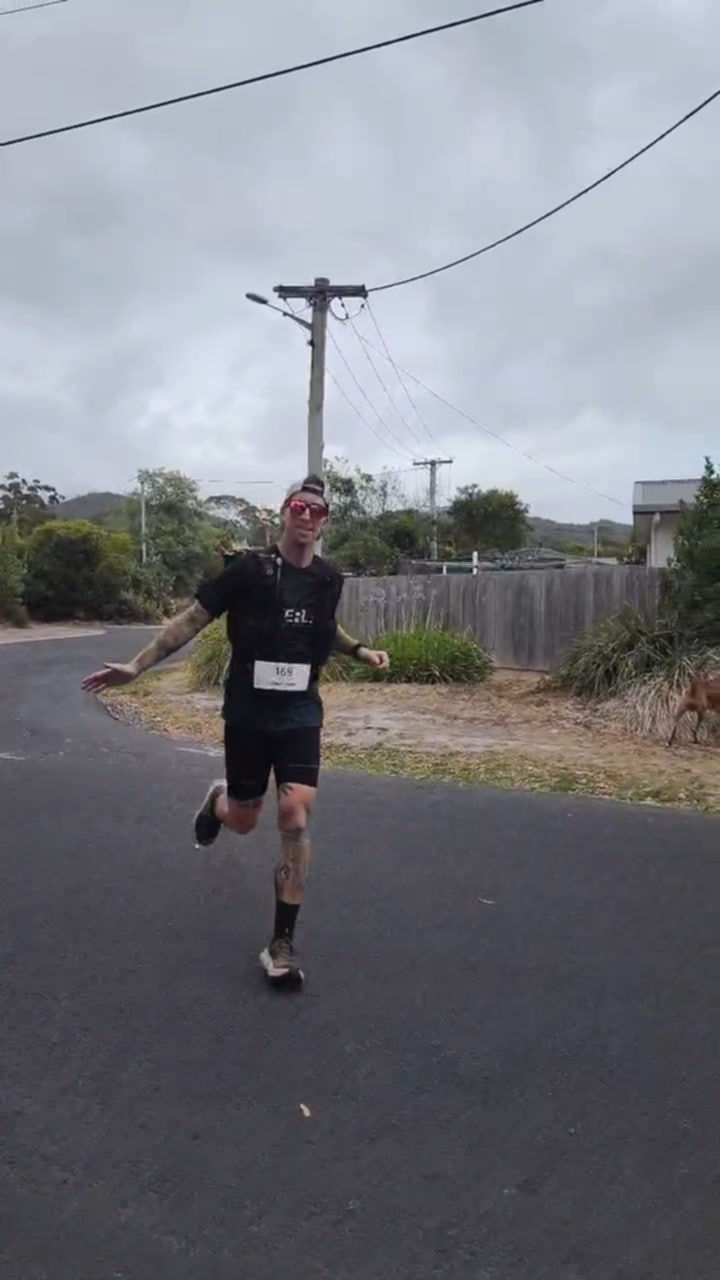
Somewhere along this section, I hit my first low.
This is fairly typical for me in ultras.
Around 30 km is when fatigue begins to show itself, and the enormity of the distance ahead really sinks in. But experience also tells me that lows are temporary. If I keep fuelling and keep moving forward, they pass. And sure enough, they do.
By the time I was descending into Sisters Beach, I was feeling good again. Paige was there, and it was a great surprise to see a familiar face waiting to say hello. Thanks for the energy boost, Mal.
Postman’s Track (44-48 km)
Next up: Postman’s Track.
Technical. Slow. Difficult. A proper goat track. How anyone runs fast through this section is beyond me.

This is where course knowledge really helps. I know this section well enough to know not to force anything. Just roll through it. Walk when needed. Take your time.
It’s only a few kilometres, and once you’re through it you reach Boat Harbour — the next checkpoint, the next refuel, and the moment you realise there’s only about 25 km left.
Despite feeling tough at the time, I was actually moving quite well through here. I clocked a split of 2h51 for Leg 2.
For comparison:
· 2023 (101 km): 3h21
· 2024 (50 km): 2h36
So 2h51 sits nicely between those efforts.
That meant I had covered 50 km in just over 5 hours, significantly faster than expected, yet overall, I still felt relatively good.
Boat Harbour (Checkpoint 2)
This time I spent a little longer at the checkpoint — 3m42 — making sure I had everything dialled for the final section.
I was feeling the heat, especially when tucked away in protected sections of trail out of the hammering headwind. Paige secured an ice bandana around my neck, I had some watermelon and Coke, and restocked bottles and gels.
As I left Boat Harbour, I began doing some mental maths.
If I could run the final section in under three hours, I’d actually be closer to eight hours than the original goal of nine. I was quietly buzzing. But the work wasn’t done yet.
Leg 3: The Final Section (50 km – Finish)

This final stretch is always the hardest.
No matter how many kilometres you’ve run before it, this section hurts.
The hills. The paddocks. The exposure. And of course… the dreaded river track.
It’s all hard — beautiful, but hard.
I kept moving. Kept eating. Kept drinking. I tried to lift my head as often as possible to look around and soak up this incredibly beautiful coastline.
This part of the course is amazing because the majority of it is on private property, so the only time you get to run it is once a year during this race.
It was hot this year. Whenever the wind dropped, it became obvious just how warm it was. I carried an extra bottle alongside my usual hydration setup, and by the end of the race, I had consumed over 8 litres of fluid.
Table Cape
Reaching the base of Heartbreak Hill is always a morale boost. The climb is long and exposed, but with course knowledge from previous years on my side, I know that once you crest that climb, there’s just one more smaller single trail rise to Table Cape, then you’re basically at the lighthouse, and from there it’s essentially all downhill to the finish. Kind of.
Ten kilometres from the lighthouse. That’s it.
I reached Table Cape feeling surprisingly good. That feeling was made even better by a surprise visit from Lukey and his kids, plus the lighthouse checkpoint crew (which has been the same team of vollies for several years) and Paige for one last fluid refill.
The River Track Reality Check
I took off for the final 10 km, bouncing across paddocks and down hills, genuinely feeling strong. I was on a high. The finish was getting closer and closer with every step. Still doing the mental maths, I was going to be close to an 8-hour finish, if only I could keep this up.
But the river track has a way of humbling you.
The longer I spent on it, the harder it got. My legs hurt. The heat was catching up with me. Even the smallest rises felt difficult to run.
Still, forward progress is all that matters.
Overtaking runners from other distances gave small bursts of energy. As the river track came to an end and the finish approached, I started seeing familiar faces. Knowing friends — and my family — were waiting at the line makes it much easier to push through the final kilometres.
About 500 metres from the finish, I saw Babis walking toward me. He had finished about an hour earlier.
He smiled, offered some words of encouragement, and gave me a high five.
A nice moment.
The Finish

The final KM or so is a flat footpath. You can see the finish line in the distance. You can hear the MC and music over the speakers. I picked up the pace and ran strong into a crowd of clapping and cheers down the finish chute.
I crossed the line and into the arms of my crew chief, Paige (the only member of the crew), and then my family as they rushed around from their position on the finish chute into the recovery zone.
Seeing them brings all of this back to reality. I can see how much admiration is in my Son’s eyes, but really, he’s just eyeing off my new shiny medal.
The best cuddles are always after big efforts like this.
Knowing my Wife selflessly supports me doing this, whilst knowing she must take care of 2 young boys (one still breastfeeding, the other full of beans), makes me very appreciative. Cat definitely has the harder job. I can’t thank her enough for her unwavering support.
And of course, Paige as well. Spending the day following me around the NW Coast to see me for all of a few minutes never goes unnoticed and makes my race so much easier.
I finished in 8 hours, 18 minutes, and 2nd place.
I was ecstatic. Not only was it well under my original goal, but it was also under the previous course record — though Babis, of course, had already taken care of that by setting a new one himself, which I believe he now holds the course record for each of the distances at this event: 101, 75, 50, & 25.
Given the training I had (or hadn’t) done leading in, I was incredibly happy with the run.
It’s a reminder of what years of consistent running can build — and how important it is to simply listen to your body and run your own race.
Recovery
I was reasonably sore afterwards, which is to be expected, but there were no niggles, no injuries, no bruised toenails, and only two very minor blisters on the foot that slipped into a puddle early on in the day.
I took two full days off, then eased back into short easy runs through the week before building straight into a 3-hour long run seven days later.
To be clear, that’s not something I’d necessarily recommend, or even something I’d usually do just 1 week after an Ultra like this. Recovery matters. My training is guided by my long-term coach, Kyle, but ultimately led by how I’m feeling — and I felt ready.
The prescription for this long run was simple: time on feet, hike as much as needed.
Looking Ahead
This race was about testing gear, nutrition, mental strategies, and problem-solving ahead of the UTA 100 Miler, where I’ll be running more than twice this distance, and likely for three times as long…or longer.
So, regardless of time or placing, this was a very successful day.
Looking back, the calmness I felt before the race wasn’t disrespect for the distance or the course. It was experience.
Not confidence in a time or outcome — but confidence in my ability to listen, adapt, and keep moving forward when things inevitably change.
I’m excited for the training ahead over the next couple of months and can’t wait to return to UTA in May.

The Blue Mountains are a very special place to run, and I’m stoked to be heading back.
Gone Nuts Recap – Total Nutter
(You are awarded the ‘Total Nutter’ for completing all distances at Gone Nuts).
2023 – 101 km – 11:43 (2nd)
2024 – 50 km – 5:43 (12th)
2025 – 25 km – 2:29 (2nd Mixed 101 Team Relay – I ran the last leg)
2026 – 75 km – 8:18 (2nd)
Distance (Year) | 0-25 km | 25-50 km | 50-75 km | 75 km-Finish | Finish Time |
101 km (2023) | 2:26:36 | 2:38:09 | 3:21:31 | 3:17:25 | 11:43:42 |
75 km (2026) | - | 2:11:25 | 2:51:50 | 3:14:52 | 8:18:09 |
50 km (2024) | - | - | 2:36:48 | 3:07:00 | 5:43:48 |
25 km (2025) | - | - | - | 2:29:39 | 2:29:39 |
Written & Edited by Zac Harris, OVERLAP Founder & Head Coach
Inspired by Zac's journey? Join the OVERLAP family! Just email us at info@overlapcoaching.com or click the button below.



Comments